Thursday October 9, 2014
6:30 pm
London Public Library
Landon Branch
167 Wortley Rd.
London, Ontario
Martha Bishop Room
FRAGRANCE FREE EVENT! Please be respectful of attendees who have serious allergies!
All are welcome! Free! Refreshments!
Donations to the coffee fund accepted gratefully!
After meet and greet and a short business meeting,
SEAN QUIGLEY
Executive Director of Emerging Leaders London Community Network,
will speak on
“Where Did All Our Talent Go?”
followed by Q&A.
"The focus of the talk will be an overview of the Economics of SWO, The Talent Drain in London, and the Inability of traditional institutions to engage with the 20 to 44 year old demographic. London has been going through a shift in economics and demographics over the last 6 years. With the huge loss of employment in our city, the mass exodus of the 20 to 44 year old demographic, and the inability of traditional clubs and institutions to resonate with this group. there is a looming choice for London. Will we look continue to look to the past or create a modern future?"
Minutes of our last monthly meeting:
http://londoncouncilofcanadians.ca/LondonCoCMeetingMinutes.pdf
October Agenda
6:30 - 7:00 coffee, tea, snacks, social
7:00 - 7:30 Business: Reports and Coming events
Chair - Roberta Cory - National CoC Conference and AGM in Hamilton
Website/social media - Rory
Trade Justice - Jennifer - report on Anti CETA action
Cinema Politica - Paula M. - "Finding Dawn” November 10, Central Library
Water - Julie - Saturday, Oct. 18, Kairos sponsored conference “Downstream”
Health - Jeff - Wed. Oct. 15, 6:00 pm Fox and Fiddle
Energy - Roberta - Global Frackdown on Saturday, Oct. 11
Food Security - Pollinator Sanctuary London - Margo
OPAL actions - every Friday at 2:00 pm - call Roberta 519-601-2053 if going
Peace - David and Paula - Friday, Oct. 10, 5:00 pm Vigil at Victoria Park
Tabling - “Voices” event - Goodwill Building - Saturday, Oct. 18, volunteers needed
London CoC AGM announcement - Jessie C., Committee Chair - Friday, November 28, 2014
Democracy - Fair Elections and Proportional Representation
7:30 - 8:30 Speaker: Sean Quigley - The London We Want: “Where Did All Our Talent Go?” Q and A
8:30 - AGM committee - meet with Jessie C.
8:45 - Cleanup volunteers needed to get out by 9:00 pm
November meeting - AGM
Wednesday, October 1, 2014
Saturday, September 20, 2014
London RALLY on the Eve of the CETA Ceremony!
We Stand on Guard for Canadian Cities!
No to CETA!
No to Investor-State!
And a Big Yes to Fair Trade!
No to Investor-State!
And a Big Yes to Fair Trade!
| The world famous CETApus of London, Ontario, 2011. |
On Thursday, Sept. 25, 2014, at 4:30 pm, outside London City Hall, you are invited to take a stand for Canadian cities. Together we will mark the historic resistance to the CETA trade pact by city councils from Victoria to Thunder Bay to Toronto. These municipal governments, along with dozens of others, including London, represent the first ever cross-country resistance to a corporate trade pact. The CETA gives corporations the right to directly sue governments if new laws or regulations impact their profits. It also removes the right of municipalities to govern local assets publicly, in favour of privatization and foreign corporate management.
Together we will acknowledge London city council, which passed two resolutions to be excluded from the CETA, for which it has received no reply from either the federal or provincial governments. This gathering will also bear witness to the official announcement, on Friday, Sept. 26th in Ottawa, that negotiations for the Canada-EU Comprehensive Economic and Trade Agreement are complete. In reality, while the agreement is nearing completion, the CETA still needs to be ratified, a process which could take up to two years.
Following the announcement, the CETA cannot be changed. But it can be rejected!
Thursday, September 25
4:30 pm – 5:30 pm
Outside City Hall (300 Dufferin Avenue, London ON)
Hosted by Council of Canadians, London Chapter
More info: www.canadians.org/trade
Local contacts:
Aldous Smith tradejusticelondon@gmail.com
Jennifer Chesnut jennifer.reanne@gmail.com
Come together, connect, and thank Canadian city councillors for standing up to protect families and democratic process.
Bring your voices, ears for listening, and determination for democracy. Stand tall together, knowing we are on the right side of history. No to CETA and Investor State! Yes to Fair Trade!
Labels:
Canada,
CETA,
corporations,
Council of Canadians,
democracy,
environment,
Europe,
Event,
food security,
Harper,
London,
Ontario,
pipeline,
privatization,
protests,
trade
Thursday, September 18, 2014
People's Climate March London, Ontario - Sept. 21, 2014
FOR IMMEDIATE RELEASE PEOPLE'S CLIMATE MARCH, LONDON, ONTARIO, SEPT. 21, 1:30 PM - RIVERSIDE DR. AT THE JET D'EAU FOUNTAIN
On Sunday, September 21, 2014, 1:30 pm at the Jet d'Eau Fountain at the Forks of the Thames, London will march in solidarity with hundreds of thousands of deeply concerned human beings around the planet to say NO to runaway climate change. The People's March in New York City expects over 100,000 people with 496 buses coming from nearly all 50 states and Canada. Those who cannot get to New York City are marching in their own cities. London will join 125 other cities in Canada, including Peterborough, Brampton, Barrie, Owen Sound, Oshawa, Belleville, Sudbury, Toronto, Burlington, Guelph, Stratford, Waterloo, Kitchener, Hamilton, St. Catherine, and Niagara on the Lake for this historic moment in history.
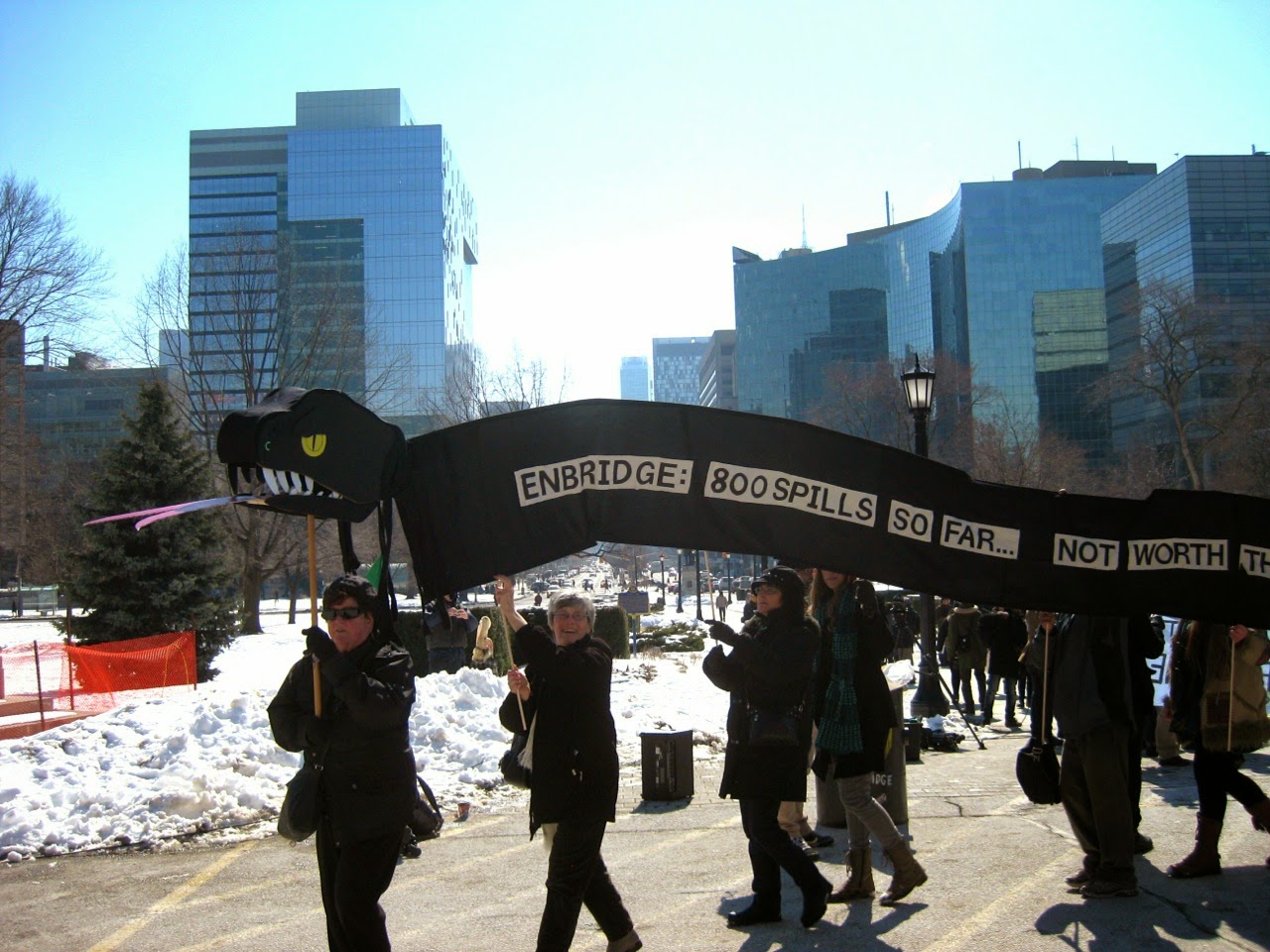
Canadians who are angry with our government for escalating climate change and have a different vision for Canada are encouraged to speak to the crowd. The renown Line 9 Snake, which made its debut in Queens Park last spring to protest the National Energy Board approval of the reversal of the 40 year old Line 9, will be walked around downtown as marchers carry signs denouncing the continued use of fossil fuels. The march will end at the Peace Garden in time for the dedication ceremony of the new Peace Plaque. This is a fitting terminus for the People's Climate March, since escalating climate change is a serious threat to world peace. Rising sea levels, deserts where people once farmed, and lack of drinking water will all lead to wars over scarce resources.
Anyone with a troubled conscience about Canada's contribution to climate change is invited to add their numbers to this historic event and join us at the Forks.
Roberta Cory
Chair, London Chapter, Council of Canadians
519-601-2053
LONDON CLIMATE MARCH!
IN SOLIDARITY WITH THE NEW YORK MARCH
SUNDAY, SEPTEMBER 21, 2014
1:30 PM AT FORKS OF THE THAMES
(next to the bridge at the water cannon off Riverside Dr.)
ANYONE CAN SPEAK (briefly)
YOUR OWN WORDS OR QUOTES
BRING SIGNS
WALK THE LINE 9 SNAKE
PHOTOS OF OUR MARCH WILL BE SENT TO JOIN THOUSANDS OF OTHERS FROM CITIES AROUND THE WORLD
WE WILL END THE MARCH AT THE PEACE GARDEN FOR THE REDEDICATION OF THE PEACE PLAQUE at 2:45 pm
YOUR OWN WORDS OR QUOTES
BRING SIGNS
WALK THE LINE 9 SNAKE
PHOTOS OF OUR MARCH WILL BE SENT TO JOIN THOUSANDS OF OTHERS FROM CITIES AROUND THE WORLD
WE WILL END THE MARCH AT THE PEACE GARDEN FOR THE REDEDICATION OF THE PEACE PLAQUE at 2:45 pm
Please go to watchdisruption.com. It is a 51 minute film that will help you understand the crucial fight against Climate change.
Tuesday, September 9, 2014
September Monthly Meeting of the London Chapter of the Council of Canadians
Documentary film: "KOCH BROTHERS EXPOSED"
Thursday September 11, 2014 at 6:00 pm - 8:45 pm in Landon Branch, London Public Library, 167 Wortley Road, Martha Bishop Room.
The September Monthly Meeting of the London Chapter of the Council of Canadians starts at 6:00 pm; the film starts at 7:30 pm.
All are welcome! Free! Refreshments!
Donations accepted gratefully!
Minutes of our June 16, 2014 Monthly Meeting:
http://londoncouncilofcanadians.ca/LondonCoCMeetingMinutes.pdf
"We've reissued Koch Brothers Exposed in an updated version, Koch Brothers Exposed: 2014 Edition, to shine a light on them. We've delved even deeper into where their money is going, who their money is hurting, and how much they are making..."
http://www.bravenewfilms.org/koch2014
Thursday September 11, 2014 at 6:00 pm - 8:45 pm in Landon Branch, London Public Library, 167 Wortley Road, Martha Bishop Room.
The September Monthly Meeting of the London Chapter of the Council of Canadians starts at 6:00 pm; the film starts at 7:30 pm.
All are welcome! Free! Refreshments!
Donations accepted gratefully!
Minutes of our June 16, 2014 Monthly Meeting:
http://londoncouncilofcanadians.ca/LondonCoCMeetingMinutes.pdf
"We've reissued Koch Brothers Exposed in an updated version, Koch Brothers Exposed: 2014 Edition, to shine a light on them. We've delved even deeper into where their money is going, who their money is hurting, and how much they are making..."
http://www.bravenewfilms.org/koch2014
Labels:
Canada,
corporations,
Council of Canadians,
democracy,
election,
energy,
environment,
London,
Ontario,
pipeline,
tar sands
Cinema Politica London Re-opens to a Full House!
Packed house at our screening of We Are Wisconsin last night! Cinema Politica London lives!...and rocks! Not a dry eye in the room! A special bonus was in person commentary from a WAW veteran, Sarah Roberts (now a Western University professor), after the film.
Next showing: "Living Downstream" on Monday Oct. 6, 2014.
http://www.cinemapolitica.org/screening/london/living-downstream
Next showing: "Living Downstream" on Monday Oct. 6, 2014.
http://www.cinemapolitica.org/screening/london/living-downstream
Labels:
Canada,
Cinema Politica,
Council of Canadians,
labour,
London,
Ontario,
protests
Monday, September 8, 2014
CINEMA POLITICA LONDON REVIVED! TODAY!

Cinema Politica London is happy to be back under new management after a two year hiatus! It is now being run by the Solidarity Film Coalition, a committee of the London Chapter of the Council of Canadians. Co-sponsors include L.A.C.A.S.A. (Latin American Canadian Solidarity Association), the London Public Library, and Seeds of Hope. Our kick-off film is, appropriately, "We Are Wisconsin", a rousing cheer leading inspiration to action for grassroots movements! It is guaranteed to knock your socks off!
TODAY! Monday Sept. 8, 2014 at 7 pm in Stevenson & Hunt Room, London Public Library, 251 Dundas St.
All of our showings are free of charge, but we do welcome donations any time.
http://www.cinemapolitica.org/london

Monday, September 1, 2014
Trade with the New Generations in Mind
I am fascinated by new generation trade pacts, described as the transfer of power from people to transnational corporations.* I find the topic both compelling and repelling. Despite the discomfort, the study of trade offers essential understanding for those interested in preserving natural life and community infrastructure from nation to nation. Years ago, my undergraduate professors startled me with the news that “new generation” trade deals give large corporations the opportunity to manage the public’s assets, and also to sue countries when public laws decrease corporate profits. Should we not ask for more in our global policy? Because if profit of the largest entities is the prime intention, than that is simply what we will get, and all the environmental and geo-political instabilities associated with that. When setting regulations between countries can we ensure resource security, vital public services, and the greater political security that comes with that?
Trade deals are written in private. What if the best in us was put forward for their composition. What if the wisest elder, with a great sense of humour, soft heart, and economic knowledge sat at the table to negotiate? Why not seek robust economy based in real jobs and environmental security?
Such global-impact regulations should be approached with loving-kindness. For no child in the so-called Global North will be secure in an insecure world and no child in the Global South, with all its restriction of access to clean water and basic human rights, will be fully nourished. We could take less in the North in exchange for greater security.
We can do better than an international trade law that allows corporations to sue nations if corporate profits decrease over the use of public laws.
People are awakening to what is truly valuable. When I think of the people in my city I see so many whose primary desire is security for families, friends and community. This is a reason to learn about trade pacts.
As a North American, the place of birth of the “New Generation” deal, I feel a responsibility to be part of general dialogue to create fairer trade. I am curious about global law after the new generation pact and what else is possible!
This blog is a creative space for exploring New Generation trade from a different perspective, one that is truly generational and focussed on what we are offering children and their children to come. In peace and faith!
Jennifer Chesnut
Trade Justice Chair
*trade pact description from Maude Barlow, Chair of the Council of Canadians
Published originally on August 30, 2014 in http://newgenerationtrade.com/2014/08/30/trade-with-the-new-generations-in-mind/
Labels:
Canada,
corporations,
Council of Canadians,
education,
environment,
Maude Barlow,
peace,
social justice,
trade
Monday, August 18, 2014
Monetary Reform
Open Letter to Hassan Yussuff:
Congratulations on your recent election as President of the Canadian Labour Congress! We who are Canadian social activists both inside and outside the CLC greatly appreciate your long-time commitment not only to wage and benefit enhancements for workers, but also to social justice and environmental protection for all of us, nationally and globally. At present we are in crisis. Despite heroic efforts by many social activists, for many years we have been losing ground to the corporate agenda. This letter proposes a strategy by which the CLC, with its 3.3 million members under your leadership, could unite Canada's many social activists into a single movement to reverse this disheartening trend.
Here is our situation, as the Making Waves document points out. In Canada there are hundreds of organizations—large and small, local, regional, and national—working valiantly on behalf of the 99% for various aspects of human and environmental welfare. We have the advantage that many highly committed people are working for the needed social changes which are supported by a large majority of Canadians. They achieve occasional victories, but mostly they are fighting losing defensive battles against exploitive initiatives by profit-oriented corporations, and against the Harper government and its lower-level government allies. Our efforts are defensive not only in the sense that they react to corporate initiatives, but also in the sense that mostly they are attempting to prevent loss of benefits we had previously enjoyed. For example we oppose cuts to health care services, education, and infrastructure, and we fight against damaging fracking, pipelines, and trade agreements. Not only are our efforts primarily defensive, but they are also largely separated from each other, as people quite reasonably take on limited issues that they can manage.
Can we find some key issue which is so crucial to the entire range of issues on which we are already working that we can all benefit by taking on this additional issue together? Might such an issue enable us to break out of our usual defensive posture and go on the offensive to reverse the Harper-supported corporate agenda and to gain new advantages that we did not previously have? Might we frame this issue vividly and dramatically as an expression of our commitment to overcome the unjust corporate agenda and to foster a caring, environmentally sensitive social order? Might this issue enable us to reduce at its heart the power of corporate elites so that they can no longer run roughshod over us and the environment?
Raising taxes on the rich would move us in the right direction. This measure is certainly needed to reduce the devastating impact of inequality which has been growing dangerously. It would reduce the power of the wealthy and would weaken the austerity agenda by providing financial resources for public benefit. Despite its obvious wisdom, it has been extremely difficult to build political support for this option, and not only because the wealthy exercise excessive power over politicians. There is widespread hostility toward taxes even among the less affluent whose taxes would not be raised. Although tax reform must not be overlooked, I suggest here that we focus on an even more powerful alternative strategy which is little known and all too much overlooked.
There is hardly any public discussion of the fact that governments at all levels in Canada are heavily burdened by interest payments on their borrowings—some $60 billion every year recently—and close to $2 trillion since 1975! These payments are not necessary! Our governments have been borrowing at interest from private banks and other private moneylenders. The federal government could have been using our publicly owned Bank of Canada to provide needed loans at near-zero interest! Nearly all our activist groups could benefit from a return to this practice which was used effectively between 1938 and 1975, enabling Canada to get out of the Depression, through World War II, and for thirty more years to build up our social programs and infrastructure, bringing the most prosperous period in Canadian history—with negligible inflation.
How does this monetary reform enable us to go on the offensive against the corporate agenda? It takes on the corporate elites at the heart of their power. This is not simply their enormous and growing wealth, but even more basically it is their control, through the privately owned banking system, over the power to create money out of nothing. They use this power to exploit us! With a return to the originally mandated purpose of the Bank of Canada, the power to create money out of nothing could be made available for public benefit. We activists need to unite to campaign for this result. An understanding of the workings of our money system is needed to clarify this strategic option. We take our present system for granted, and have little awareness how unjust and damaging it is.
What is money, and where does it come from? We generally assume that government supplies our money, and indeed it does provide the cash we carry for small transactions. But cash is only about 2% to 3% of our money supply. Nearly all the rest, about 97% to 98%—money essential for facilitating economic activity—has been created as computer entries by the privately owned banks in their process of making loans. They would like us to believe that they are simply intermediators lending out the money of depositors. But this is not the case. When they make loans they create new money. When someone takes out a loan, the bank insists that the borrower provide collateral, some valuable asset that the bank can take over in case the borrower defaults on the loan. The bank gets to create that loan money out of nothing, and if we borrowers fail to pay it back fully, on time, with interest, the bank gets to take over our valuable collateral.
That is bad enough. But it gets worse. When banks make loans, they create money for principal, but not for the interest they require to be paid. Borrowers have to compete with each other for money which has been created only as principal to pay both principal and interest, and also to have money for essential current use. People who owe nothing are also competing to use this same money supply. As competition prevails, impulses toward cooperation and charity are undermined. In this debt-money system there is always a shortage of money. Money to pay interest can only be obtained through even more borrowing and more debt. Obviously this is unsustainable. Defaults come on inevitably, and recession follows.
This system is also inflationary. To pay interest along with their other expenses, businesses constantly strive to push up prices. In response, workers strive to raise wages. Hence inflation. The interest requirement is also a factor in driving businesses to pursue unsustainable growth. Moreover, as those who are economically vulnerable default on their loans, many are driven into poverty, and wealth becomes increasingly concentrated into the hands of a few, exacerbating the growing problem of inequality.
When borrowers pay off their loans the banks keep the interest as their own, but they destroy the principal. The creators of money are also its destroyers! This is an enormous additional source of power often used to our disadvantage. If all borrowers—governments, businesses, and individuals—strove to exercise the virtue of thrift by paying off their debts, long before succeeding they would have driven the economy into deep depression.
We are all in thrall to the banks—even those of us who carry no debt. On average about 40% of the prices of all the goods in our society is the result of accumulating interest expenses! We could begin to reverse this and all the other damaging impacts of our money system by returning to using our publicly owned Bank of Canada to provide interest-free loans to all levels of government for public benefit. A bit more explanation is needed here.
The power to create money out of nothing is awesome. Whoever gets to benefit from the first use of newly created money gets a free benefit! The process is essentially the same as when counterfeiters print and successfully pass off cash. But they face the difficulties of devising convincing facsimiles of modern cash, and they run the risk of arrest and punishment. Commercial banks can, entirely legally, quickly create any desired quantity of money with simple computer entries. This is easier than picking money off trees. And they tell us there is no such thing as a free lunch!
Our Bank of Canada could use this same simple process to create money for public benefit, as it did in the past. It can lend money into existence—say, for investment in much-needed infrastructure, thus creating lots of jobs. At present governments borrow at interest and pay for such projects two or three times over. Interest-free loans would make it possible for them to pay for the projects just once out of tax income over the lifetime of each project—perhaps 30 to 50 years. This would free large amounts of tax funds for current program spending.
There is another astonishing possibility. When additional new money is needed in the economy, as now, governments could simply spend money into existence as a free benefit for public use. Whether government-created money is lent or spent into existence, debt-free money is injected into the economy, making possible great reductions in the far-reaching problems resulting, as already mentioned, from our present destructive debt-money system. And governments could have access to abundant funds for initiating creative measures for social and environmental welfare, while gradually reducing their past debts.
Having money-creation under government control is no panacea. Spending for human and environmental abuse, as in war, remains possible. Any campaign for monetary reform is a struggle for democratization of our money system, and such a campaign can readily be integrated with the wider struggle for greater democracy. We need to develop a high degree of public awareness regarding how our money system works, and procedures to assure that full, accurate, transparent information on the functioning of the system is publicly available, and widespread commitment to assuring that the system is benevolently used. Strong public understanding and support are necessary to resist the intense opposition that banks can be fully expected to mount against monetary reform.
We must not wilt before the inevitable claim that government-created money is inflationary. We need to emphasize how damaging our present bank-created debt-money system itself is. It has its own long record of promoting steady, ongoing inflation, as already explained here. Inflationary pressures are built into its very genes. Moreover, there is much evidence to indicate that when governments have controlled their own money-creation they have managed their economies with very little inflation, as Canada did between 1938 and 1975. The record shows that hyperinflations, including that of Germany in the 1920s, were not driven by government irresponsibility, but by wealthy speculators, including banks, manipulating national currencies to their own great advantage (see Ellen Brown, The Web of Debt).
While there are additional complexities regarding our money system which specialists in monetary reform need to master, the basics have been presented here. A campaign for monetary reform must aim to get elected a federal government which will use the Bank of Canada to create money out of nothing for public benefit as originally intended by the Bank of Canada Act, and as was done between 1938 and 1975. Here are five compelling reasons why activists should unite in a campaign to achieve this end:
1. This campaign would enable us to go on the offensive against the power of corporate elites at its heart: their monopoly over the creation of money.
2. This campaign would enable us to go on the offensive against our corporate antagonists so that they have to expend energy and give attention to our initiatives rather than forcing us simply to take defensive actions against their assaults on our welfare.
3. This campaign would enable us to take action which is critical for all our separate struggles, and to combine our strengths into a single struggle.
4. Victory in this struggle would not simply maintain or restore a previous beneficial status quo. It would defend us against the debt-driven, exploitive austerity agenda by enabling us to pay off public debts while providing abundant funding for improvements and initiatives for public benefit.
5. If in our campaign we focus attention on the glaring injustices resulting from the elites' outrageous monopoly over the creation of money out of nothing, a power that could be made available for public benefit as in our past, we can make a compelling, dramatic case for our cause.
A campaign for monetary reform will certainly be demanding. It requires bringing together many activist groups which already have challenging agendas. It requires a massive public education effort without assistance from the mainline media. It will face ferocious opposition from the banks, with the full assistance of the mainline media. It will need to convince a reluctant NDP to take up this cause. The Committee on Monetary and Economic Reform (COMER) has been working on this issue since the 1980's, and has much expertise, but has insufficient strength to manage the task alone. Nevertheless it has in progress a lawsuit against the federal government for its failure to carry out the mandate of the Bank of Canada Act. Apparently there is no other organization in Canada better situated than the CLC to lead a campaign for monetary reform. It is a tough assignment. But we need your leadership. Success could reverse the corporate agenda, and bring spectacular social and environmental improvement.
George Crowell, member of COMER, taught Social Ethics in the Religious Studies Department, University of Windsor, 1968-96.
Congratulations on your recent election as President of the Canadian Labour Congress! We who are Canadian social activists both inside and outside the CLC greatly appreciate your long-time commitment not only to wage and benefit enhancements for workers, but also to social justice and environmental protection for all of us, nationally and globally. At present we are in crisis. Despite heroic efforts by many social activists, for many years we have been losing ground to the corporate agenda. This letter proposes a strategy by which the CLC, with its 3.3 million members under your leadership, could unite Canada's many social activists into a single movement to reverse this disheartening trend.
Here is our situation, as the Making Waves document points out. In Canada there are hundreds of organizations—large and small, local, regional, and national—working valiantly on behalf of the 99% for various aspects of human and environmental welfare. We have the advantage that many highly committed people are working for the needed social changes which are supported by a large majority of Canadians. They achieve occasional victories, but mostly they are fighting losing defensive battles against exploitive initiatives by profit-oriented corporations, and against the Harper government and its lower-level government allies. Our efforts are defensive not only in the sense that they react to corporate initiatives, but also in the sense that mostly they are attempting to prevent loss of benefits we had previously enjoyed. For example we oppose cuts to health care services, education, and infrastructure, and we fight against damaging fracking, pipelines, and trade agreements. Not only are our efforts primarily defensive, but they are also largely separated from each other, as people quite reasonably take on limited issues that they can manage.
Can we find some key issue which is so crucial to the entire range of issues on which we are already working that we can all benefit by taking on this additional issue together? Might such an issue enable us to break out of our usual defensive posture and go on the offensive to reverse the Harper-supported corporate agenda and to gain new advantages that we did not previously have? Might we frame this issue vividly and dramatically as an expression of our commitment to overcome the unjust corporate agenda and to foster a caring, environmentally sensitive social order? Might this issue enable us to reduce at its heart the power of corporate elites so that they can no longer run roughshod over us and the environment?
Raising taxes on the rich would move us in the right direction. This measure is certainly needed to reduce the devastating impact of inequality which has been growing dangerously. It would reduce the power of the wealthy and would weaken the austerity agenda by providing financial resources for public benefit. Despite its obvious wisdom, it has been extremely difficult to build political support for this option, and not only because the wealthy exercise excessive power over politicians. There is widespread hostility toward taxes even among the less affluent whose taxes would not be raised. Although tax reform must not be overlooked, I suggest here that we focus on an even more powerful alternative strategy which is little known and all too much overlooked.
There is hardly any public discussion of the fact that governments at all levels in Canada are heavily burdened by interest payments on their borrowings—some $60 billion every year recently—and close to $2 trillion since 1975! These payments are not necessary! Our governments have been borrowing at interest from private banks and other private moneylenders. The federal government could have been using our publicly owned Bank of Canada to provide needed loans at near-zero interest! Nearly all our activist groups could benefit from a return to this practice which was used effectively between 1938 and 1975, enabling Canada to get out of the Depression, through World War II, and for thirty more years to build up our social programs and infrastructure, bringing the most prosperous period in Canadian history—with negligible inflation.
How does this monetary reform enable us to go on the offensive against the corporate agenda? It takes on the corporate elites at the heart of their power. This is not simply their enormous and growing wealth, but even more basically it is their control, through the privately owned banking system, over the power to create money out of nothing. They use this power to exploit us! With a return to the originally mandated purpose of the Bank of Canada, the power to create money out of nothing could be made available for public benefit. We activists need to unite to campaign for this result. An understanding of the workings of our money system is needed to clarify this strategic option. We take our present system for granted, and have little awareness how unjust and damaging it is.
What is money, and where does it come from? We generally assume that government supplies our money, and indeed it does provide the cash we carry for small transactions. But cash is only about 2% to 3% of our money supply. Nearly all the rest, about 97% to 98%—money essential for facilitating economic activity—has been created as computer entries by the privately owned banks in their process of making loans. They would like us to believe that they are simply intermediators lending out the money of depositors. But this is not the case. When they make loans they create new money. When someone takes out a loan, the bank insists that the borrower provide collateral, some valuable asset that the bank can take over in case the borrower defaults on the loan. The bank gets to create that loan money out of nothing, and if we borrowers fail to pay it back fully, on time, with interest, the bank gets to take over our valuable collateral.
That is bad enough. But it gets worse. When banks make loans, they create money for principal, but not for the interest they require to be paid. Borrowers have to compete with each other for money which has been created only as principal to pay both principal and interest, and also to have money for essential current use. People who owe nothing are also competing to use this same money supply. As competition prevails, impulses toward cooperation and charity are undermined. In this debt-money system there is always a shortage of money. Money to pay interest can only be obtained through even more borrowing and more debt. Obviously this is unsustainable. Defaults come on inevitably, and recession follows.
This system is also inflationary. To pay interest along with their other expenses, businesses constantly strive to push up prices. In response, workers strive to raise wages. Hence inflation. The interest requirement is also a factor in driving businesses to pursue unsustainable growth. Moreover, as those who are economically vulnerable default on their loans, many are driven into poverty, and wealth becomes increasingly concentrated into the hands of a few, exacerbating the growing problem of inequality.
When borrowers pay off their loans the banks keep the interest as their own, but they destroy the principal. The creators of money are also its destroyers! This is an enormous additional source of power often used to our disadvantage. If all borrowers—governments, businesses, and individuals—strove to exercise the virtue of thrift by paying off their debts, long before succeeding they would have driven the economy into deep depression.
We are all in thrall to the banks—even those of us who carry no debt. On average about 40% of the prices of all the goods in our society is the result of accumulating interest expenses! We could begin to reverse this and all the other damaging impacts of our money system by returning to using our publicly owned Bank of Canada to provide interest-free loans to all levels of government for public benefit. A bit more explanation is needed here.
The power to create money out of nothing is awesome. Whoever gets to benefit from the first use of newly created money gets a free benefit! The process is essentially the same as when counterfeiters print and successfully pass off cash. But they face the difficulties of devising convincing facsimiles of modern cash, and they run the risk of arrest and punishment. Commercial banks can, entirely legally, quickly create any desired quantity of money with simple computer entries. This is easier than picking money off trees. And they tell us there is no such thing as a free lunch!
Our Bank of Canada could use this same simple process to create money for public benefit, as it did in the past. It can lend money into existence—say, for investment in much-needed infrastructure, thus creating lots of jobs. At present governments borrow at interest and pay for such projects two or three times over. Interest-free loans would make it possible for them to pay for the projects just once out of tax income over the lifetime of each project—perhaps 30 to 50 years. This would free large amounts of tax funds for current program spending.
There is another astonishing possibility. When additional new money is needed in the economy, as now, governments could simply spend money into existence as a free benefit for public use. Whether government-created money is lent or spent into existence, debt-free money is injected into the economy, making possible great reductions in the far-reaching problems resulting, as already mentioned, from our present destructive debt-money system. And governments could have access to abundant funds for initiating creative measures for social and environmental welfare, while gradually reducing their past debts.
Having money-creation under government control is no panacea. Spending for human and environmental abuse, as in war, remains possible. Any campaign for monetary reform is a struggle for democratization of our money system, and such a campaign can readily be integrated with the wider struggle for greater democracy. We need to develop a high degree of public awareness regarding how our money system works, and procedures to assure that full, accurate, transparent information on the functioning of the system is publicly available, and widespread commitment to assuring that the system is benevolently used. Strong public understanding and support are necessary to resist the intense opposition that banks can be fully expected to mount against monetary reform.
We must not wilt before the inevitable claim that government-created money is inflationary. We need to emphasize how damaging our present bank-created debt-money system itself is. It has its own long record of promoting steady, ongoing inflation, as already explained here. Inflationary pressures are built into its very genes. Moreover, there is much evidence to indicate that when governments have controlled their own money-creation they have managed their economies with very little inflation, as Canada did between 1938 and 1975. The record shows that hyperinflations, including that of Germany in the 1920s, were not driven by government irresponsibility, but by wealthy speculators, including banks, manipulating national currencies to their own great advantage (see Ellen Brown, The Web of Debt).
While there are additional complexities regarding our money system which specialists in monetary reform need to master, the basics have been presented here. A campaign for monetary reform must aim to get elected a federal government which will use the Bank of Canada to create money out of nothing for public benefit as originally intended by the Bank of Canada Act, and as was done between 1938 and 1975. Here are five compelling reasons why activists should unite in a campaign to achieve this end:
1. This campaign would enable us to go on the offensive against the power of corporate elites at its heart: their monopoly over the creation of money.
2. This campaign would enable us to go on the offensive against our corporate antagonists so that they have to expend energy and give attention to our initiatives rather than forcing us simply to take defensive actions against their assaults on our welfare.
3. This campaign would enable us to take action which is critical for all our separate struggles, and to combine our strengths into a single struggle.
4. Victory in this struggle would not simply maintain or restore a previous beneficial status quo. It would defend us against the debt-driven, exploitive austerity agenda by enabling us to pay off public debts while providing abundant funding for improvements and initiatives for public benefit.
5. If in our campaign we focus attention on the glaring injustices resulting from the elites' outrageous monopoly over the creation of money out of nothing, a power that could be made available for public benefit as in our past, we can make a compelling, dramatic case for our cause.
A campaign for monetary reform will certainly be demanding. It requires bringing together many activist groups which already have challenging agendas. It requires a massive public education effort without assistance from the mainline media. It will face ferocious opposition from the banks, with the full assistance of the mainline media. It will need to convince a reluctant NDP to take up this cause. The Committee on Monetary and Economic Reform (COMER) has been working on this issue since the 1980's, and has much expertise, but has insufficient strength to manage the task alone. Nevertheless it has in progress a lawsuit against the federal government for its failure to carry out the mandate of the Bank of Canada Act. Apparently there is no other organization in Canada better situated than the CLC to lead a campaign for monetary reform. It is a tough assignment. But we need your leadership. Success could reverse the corporate agenda, and bring spectacular social and environmental improvement.
George Crowell, member of COMER, taught Social Ethics in the Religious Studies Department, University of Windsor, 1968-96.
Labels:
Canada,
Council of Canadians,
monetary policy
Sunday, August 10, 2014
Beekeepers running out of time
Letter to London Free Press Aug 9 2014 Beekeepers running out of time
I am pleased to see an editorial comment on the pollinator crisis (Bee health worth million-dollar study, Aug. 5). Fred Rinne brings out some important points, for example that the topic needs more attention and humans are “messing with” the cycle of life. He also states that the federal government plans to spend more than $1million over a four-year period to study this issue. This may give the appearance that something is being done, however, many science-based studies have taken place over the past several years. Health Canada has come out with the report “Evaluation of Canadian Bee Mortalities that Coincided with Corn Planting” in Spring 2012, and issued the notice of intent, “Action to Protect Bees from Exposure to Neonicotinoid Pesticides” on Sept. 13, 2013. In this report, the Pest Management Regulatory Agency “has determined that current agricultural practices related to the use of neonicotinoid treated corn and soybean seeds are affecting the environment due to their impacts on bees and other pollinators.” Many other studies have been conducted through reputable institutions, including the University of Guelph, and our Ontario Bee Health Work Group, led by entomologist Tracy Baute, have shown that there are definite linkages between decline of the honey bees (and possibly other pollinators) and the use of pesticides, such as clothianidin and others. Perhaps the time for study is over, and a time for concrete action can begin. The governments should be listening more to the beekeepers and working much more closely with Ontario Beekeepers Association, rather than just throwing another study at this situation stretching over a long period of time. Time is something that the bees don’t have nor do the beekeepers, or fruit and vegetable growers.
Margo Does
London
Labels:
bees,
Canada,
Council of Canadians,
environment,
food security,
London,
neonicotinoids,
Ontario,
pollination
Wednesday, July 9, 2014
London Regional Social Forum, July 11-13, 2014
Final program:
http://londoncouncilofcanadians.ca/LondonRegionalSocialForum2014.pdf
Facebook page:
https://www.facebook.com/events/464484100320894/
![]() |
| Kamilla Pietrzyk |
![]() |
| Ajamu Nangwaya |
Then at 9:00 pm there will be rousing Musical Entertainment at East Village Coffee House, for which Tickets are available: $8 /sliding scale.
The spectacular program for Saturday July 12, 2014 promises to be a blockbuster, starting with a Panel Discussion at 10:00 a.m. on "Building Movement and Broad Resistance to the Right in Canada", With long-time activists and authors from across Canada: Tony Clarke, Carol Baker, Ken Lewenza Jr. and Matt Price with Murray Dobbin via Skype, followed by a Q and A session moderated by Patti Dalton. From 1:30 pm to 4:30 pm there will be a wide variety of workshops, including "The Fight to Protect our Groundwater", "Understanding and Resisting the Expansion of the Prison State", "Global-Local Solidarity with Palestine: Gaza's Ark and BDS", "Anarchist Perspectives", "Residential Schooling and the Indian Education Act: Why all the Hype?", "Peace Process in Colombia", "The Ontario Common Front", and "Grassroots Resistance to Line Nine". Following the workshops everyone is invited to join in on a walk led by the infamous giant LINE 9 SNAKE, and, if enough puppeteers are available, the giant Blue Water Serpent will come too. Both puppets are 30 feet long. Participants will decide on the details of the walk!
Finally, Rabble.ca is holding a Book Launch at 7:00 pm for "The Best of Rabble 2014: The Year of Living Consciously"! Wow! Just wow!
Rain can have no effect on the program (all inside) on Sunday July 13, 2014, the grand finale, with eight more fabulous workshops starting at 10:00 a.m., including "Mayan Communities Fight Back Against Canadian Mining Companies: The case of the community of El Estor against Hudbay Minerals", "Exploring the Life and Legacy of Rachel Carson", "NGO-ization", "Women and Leadership in a Changing World", "Mesoamerica Resiste: a global struggle against capitalism", "Power to the 99% through Monetary Transformation", "Building Community: The Invisibles of Organizing", and "Alternative Media Panel Discussion".
Lunch will be provided by London's renowned Food Not Bombs group, and the Forum will be concluded with a Presentation at 4:00 p.m. on The People's Social Forum, Ottawa, Aug. 21-24, 2014 and a discussion of ideas for the PSF and the future of social forums in general and the London Regional Social Forum in particular. Once again we will be entertained by the biting guitar and wit of Margo Does as she sings us out following closing remarks by Meg Borthwick. What a day!
Labels:
Canada,
climate change,
climate justice,
Council of Canadians,
energy,
environment,
Event,
landfill,
London,
mining,
monetary policy,
oil,
Ontario,
Palistine,
pipeline,
protests,
social justice,
tar sands,
water
Friday, June 6, 2014
Warning: Our Bank Deposits Are No Longer Safe
As a result of recent changes to the rules governing the financial system operating throughout the G20 nations, a serious threat has arisen to the finances of individuals, families, and institutions that have entrusted their assets to major banks. Here is the situation: in case "systemically important" banks should fail, they are now authorized to take over the assets of their clients, including our deposits! This procedure is known as a "bail-in”—as distinguished from a "bail-out”—and it has already been implemented in Cyprus. This threat has been thoroughly documented by Ellen Hodgson Brown (author of two extraordinary books on our money system, The Web of Debt, and, just published, The Public Bank Solution), and by the Public Banking Institute, which she founded. For a vivid, compelling explanation of the crisis provided by the Institute, see this brief video: http://www.youtube.com/watch?v=f-sHAwNfoL4 . Given the vast, destabilizing involvement of major banks in derivatives gambling, about ten times the volume of the real economy as this video shows, major banks are constantly at risk of failing, and suddenly triggering a bail-in assault on our assets. The peril is especially clear in Canada which legalized the bail-in procedure in its 2013 Federal Budget. See: www.policyalternatives.ca/publications/monitor/depositors-beware . But this bail-in agenda was mandated for all the G20 nations at their 2011 meeting, and it is likely to be reenforced by provisions of the “free trade agreements” presently being negotiated by Canada and the U.S. with the European Union, and the Trans-Pacific Partnership.
In Canada our Finance Department has assured us that our deposits remain safely protected by the Canada Deposit Insurance Corporation. But in fact the CDIC (as of April 30, 2013) had only $2.6 billion to insure $665 billion of deposits in Canadian banks. The situation in the U.S. is similar, with the Federal Deposit Insurance Corporation having about $28 billion available to insure between six and seven trillion dollars of deposits. Paltry protection from a major meltdown like that of 2008. Moreover, we also have uninsured assets entrusted to banks, including insurance and pensions. These also are vulnerable to bail-in procedures.
Having been assured that the bail-in rescue plan is readily available in case they fail, banks are all the more likely to participate in speculative activity. When driven to insolvency by their losses in derivatives gambling, the losing banks' first priority must be to pay off the winning banks ("counter parties") with whatever resources they can muster, now including their clients' assets—our financial resources. The outrage of bail-ins includes the "super-priority status" of bank counter parties over our claims as bank clients. Another version of the bail-in process is the raiding of pension funds of workers in order to pay off the big lenders. This is occurring now in some of our cities.
The danger from bail-ins will be especially high as long as the US government remains on the verge of defaulting on its debts. Although the October 17 default has been avoided, if a default should occur, the global financial system, with some $700 trillion of speculative derivatives churning around, may be thrown into the sort of chaos that would bring a major financial meltdown, perhaps surpassing that of 2008, with many bank failures resulting in bail-ins, bringing a massive shift of financial resources from the middle class to the already obscenely wealthy. Even if we escape this type of peril in the short run, the threat to our financial welfare from the banks' speculative excesses remains imminent.
Ultimately it will require persistent political action to eliminate the grossly unjust bail-in threat—e.g., outlawing bail-ins altogether, imposing a financial transactions tax, restoring the Glass-Steagall Act (which separated investment banking—mostly derivatives gambling now—from depository banking and insurance). The movement to develop public banking, including establishment of postal savings banks in which depositors' funds would be completely safe, needs strong public support.
The bail-in threat is a new development of which hardly anyone is aware. And that is the big problem. We have become so accustomed to trusting banks to keep our financial resources safe that it is hard to believe the bail-in threat could be real or imminent. Of course there is no way of knowing how great the danger is. But this new situation certainly gives reason for concern. What precautions might we take to protect ourselves and the institutions we value? We all need to be seeking alternatives to the mainline banks that we can no longer trust. In the absence of public banks and local currencies, and short of storing cash under our mattresses, it may be possible for us individuals and institutions to find safe haven at least for some of our financial resources by using credit unions. The risk probably differs from one credit union to another. We need to explore with each specific credit union the extent to which members' assets are entrusted to major banks—preferably not at all. We need to consider becoming active credit union members, constantly vigilant regarding the safety of our collective resources. We can no longer take it for granted that our bank deposits are safe.
George Crowell
georgecrowell@rogers.com
In Canada our Finance Department has assured us that our deposits remain safely protected by the Canada Deposit Insurance Corporation. But in fact the CDIC (as of April 30, 2013) had only $2.6 billion to insure $665 billion of deposits in Canadian banks. The situation in the U.S. is similar, with the Federal Deposit Insurance Corporation having about $28 billion available to insure between six and seven trillion dollars of deposits. Paltry protection from a major meltdown like that of 2008. Moreover, we also have uninsured assets entrusted to banks, including insurance and pensions. These also are vulnerable to bail-in procedures.
Having been assured that the bail-in rescue plan is readily available in case they fail, banks are all the more likely to participate in speculative activity. When driven to insolvency by their losses in derivatives gambling, the losing banks' first priority must be to pay off the winning banks ("counter parties") with whatever resources they can muster, now including their clients' assets—our financial resources. The outrage of bail-ins includes the "super-priority status" of bank counter parties over our claims as bank clients. Another version of the bail-in process is the raiding of pension funds of workers in order to pay off the big lenders. This is occurring now in some of our cities.
The danger from bail-ins will be especially high as long as the US government remains on the verge of defaulting on its debts. Although the October 17 default has been avoided, if a default should occur, the global financial system, with some $700 trillion of speculative derivatives churning around, may be thrown into the sort of chaos that would bring a major financial meltdown, perhaps surpassing that of 2008, with many bank failures resulting in bail-ins, bringing a massive shift of financial resources from the middle class to the already obscenely wealthy. Even if we escape this type of peril in the short run, the threat to our financial welfare from the banks' speculative excesses remains imminent.
Ultimately it will require persistent political action to eliminate the grossly unjust bail-in threat—e.g., outlawing bail-ins altogether, imposing a financial transactions tax, restoring the Glass-Steagall Act (which separated investment banking—mostly derivatives gambling now—from depository banking and insurance). The movement to develop public banking, including establishment of postal savings banks in which depositors' funds would be completely safe, needs strong public support.
The bail-in threat is a new development of which hardly anyone is aware. And that is the big problem. We have become so accustomed to trusting banks to keep our financial resources safe that it is hard to believe the bail-in threat could be real or imminent. Of course there is no way of knowing how great the danger is. But this new situation certainly gives reason for concern. What precautions might we take to protect ourselves and the institutions we value? We all need to be seeking alternatives to the mainline banks that we can no longer trust. In the absence of public banks and local currencies, and short of storing cash under our mattresses, it may be possible for us individuals and institutions to find safe haven at least for some of our financial resources by using credit unions. The risk probably differs from one credit union to another. We need to explore with each specific credit union the extent to which members' assets are entrusted to major banks—preferably not at all. We need to consider becoming active credit union members, constantly vigilant regarding the safety of our collective resources. We can no longer take it for granted that our bank deposits are safe.
George Crowell
georgecrowell@rogers.com
Labels:
Canada,
corporations,
Council of Canadians,
London,
monetary policy,
Ontario,
privatization
Tuesday, May 13, 2014
Council of Canadians, London Chapter updates, May, 2014/ Line 9 Pledge of Resistance
Dear Activists -
Since we were not able to send the minutes of the April 14 meeting out until this late date (BUSY doing CoC work) here are the updates and CHANGES to the minutes:
1) Earth Day in Ingersoll was wonderful - met George Henry, Chippewa of the Thames , and will work with him against Line 9 and to save the Thames River - Maude Barlow helped walk the Water Serpent - lots of us went.
2) Earth Day in London - Water Serpent taken around by Boys' and Girls' Club -Thank you Cathy Quinlan, Paula Papel, and Daisy Oliver.
3) Defend our Climate Day of Action - Two actions: Lead Now event in Victoria Park got a crowd, and 50 people from all over, Guelph, Kitchener, Toronto, Sarnia, and London went on the Toxic Tour in Sarnia, got educated (it is appalling - I will share more at a later date) and supported the Aamjiwnaang First Nation in solidarity. Line 9 Snake and Water Serpent marched in a stiff wind with 24 puppeteers. Important to continue to support them in anyway we can. Serious situation!
4) Tzeporah Berman spoke at the Central Library last night and energized the audience - a new crowd - lots of potential activists for the important anti-Line 9 campaign we are engaged in here in London. See Rising Tide Toronto message below. Google - Not Worth the Risk Report - read it - print out copies - share it with friends - PLEASE
5) New place for our meetings needed - Tolpuddle most likely not available - please look around for free, can hold 25, can show films, central and easy to get to with free parking. Write us back if you find somewhere.
6) June meeting date and place not found at this time. It will still be a potluck and George Crowell will speak about the Bank of Canada and how it will help solve some of Canada's problems.
7) Our Solidarity Film Coalition will be hosting Cinema Politica next fall.
8) SLAVERY was eliminated, WOMEN have the vote, the VIETNAM WAR ended, ENDANGERED SPECIES have been protected and populations are returning, the UN passed the RIGHT TO WATER resolution, LABOUR UNIONS created decent working conditions where there were none before, we have MEDICARE ………….all these happened through grassroots organizing, relentless resistance, patience, and networking. Today the issues are CLIMATE CHANGE and holding on to DEMOCRACY.
9) EACH OF US has a little time and some skills and experience. TOGETHER WE ARE A FORCE. WHAT WILL YOU DO?
Roberta Cory, Chair
Council of Canadians, London
----------------------------------------
From: "Rising Tide Toronto via Leadnow.ca"
Subject: Update: Line 9 Pledge of Resistance
Date: 13 May, 2014 9:52:18 AM EDT
Hi there!
Rising Tide Toronto would like to send you a (delayed) thank you for being one of over 600 people to take our Line 9 Pledge of Resistance. It's powerful to think what over 600 of us can accomplish for our communities and our environment if we work together to stop this reckless project from being built.
With construction along Line 9 rapidly moving forward, it is more important than ever for us to stand together to protect our communities, our environment and our future, and we need to be able to keep you updated on what's happening, and how people who've taken the Pledge of Resistance can take action.
To make our ongoing organizing as easy as possible, the folks at Leadnow - whose awesome petition system we used for the pledge of resistance - have said we can keep you updated directly via our own Rising Tide Toronto mailing list, rather than Leadnow's system, as long as that's OK with you.
Of course, we're deeply committed to respecting your privacy, and rest assured, Rising Tide Toronto will never spam you. All our emails are sent with the understanding that you, like all of us, likely have a busy schedule to manage. We only hope that RTT can help you to nonetheless stay up-to-date and involved on this important issue that affects all of us.
This email is coming from Leadnow's petition system. If you would prefer not to get updates directly from Rising Tide Toronto in future, please just click the "opt out" link at the bottom of this message. (You can also opt out in the future at any time as well.)
In Solidarity Always,
Rising Tide Toronto
------------------------------------------
http://londoncouncilofcanadians.ca/LondonCoCMeetingMinutes.pdf
Since we were not able to send the minutes of the April 14 meeting out until this late date (BUSY doing CoC work) here are the updates and CHANGES to the minutes:
1) Earth Day in Ingersoll was wonderful - met George Henry, Chippewa of the Thames , and will work with him against Line 9 and to save the Thames River - Maude Barlow helped walk the Water Serpent - lots of us went.
2) Earth Day in London - Water Serpent taken around by Boys' and Girls' Club -Thank you Cathy Quinlan, Paula Papel, and Daisy Oliver.
3) Defend our Climate Day of Action - Two actions: Lead Now event in Victoria Park got a crowd, and 50 people from all over, Guelph, Kitchener, Toronto, Sarnia, and London went on the Toxic Tour in Sarnia, got educated (it is appalling - I will share more at a later date) and supported the Aamjiwnaang First Nation in solidarity. Line 9 Snake and Water Serpent marched in a stiff wind with 24 puppeteers. Important to continue to support them in anyway we can. Serious situation!
4) Tzeporah Berman spoke at the Central Library last night and energized the audience - a new crowd - lots of potential activists for the important anti-Line 9 campaign we are engaged in here in London. See Rising Tide Toronto message below. Google - Not Worth the Risk Report - read it - print out copies - share it with friends - PLEASE
5) New place for our meetings needed - Tolpuddle most likely not available - please look around for free, can hold 25, can show films, central and easy to get to with free parking. Write us back if you find somewhere.
6) June meeting date and place not found at this time. It will still be a potluck and George Crowell will speak about the Bank of Canada and how it will help solve some of Canada's problems.
7) Our Solidarity Film Coalition will be hosting Cinema Politica next fall.
8) SLAVERY was eliminated, WOMEN have the vote, the VIETNAM WAR ended, ENDANGERED SPECIES have been protected and populations are returning, the UN passed the RIGHT TO WATER resolution, LABOUR UNIONS created decent working conditions where there were none before, we have MEDICARE ………….all these happened through grassroots organizing, relentless resistance, patience, and networking. Today the issues are CLIMATE CHANGE and holding on to DEMOCRACY.
9) EACH OF US has a little time and some skills and experience. TOGETHER WE ARE A FORCE. WHAT WILL YOU DO?
Roberta Cory, Chair
Council of Canadians, London
----------------------------------------
From: "Rising Tide Toronto via Leadnow.ca"
Sunday, May 4, 2014
Climate Day of Action, May 10, 2014: Sarnia, Here We Come!
Toxic Tour in Sarnia for the Climate Day of Action on May 10, 2014 looks like it's attracting large numbers of peeps from all over Ontario! The place to be! There should be plenty of puppeteers to operate both giant 30 foot long snake puppets, the Black Line 9 Snake (representing tar sands pipelines) and the Blue Water Snake (representing our precious fresh water, especially the Great Lakes and associated waterways and watersheds). Plans for the snakes include taking the Black Line 9 Snake from Sarnia to the terminus of Line 9 in Quebec and taking the Blue Water Snake from the headwaters of the Thames River to its mouth on Lake St. Clair. The Toxic Tour on May 10 would be the first time both snake puppets have appeared together! Hoping for nice weather, because they can't be used in the rain... If you need a ride to Sarnia from London call Roberta 5196012053.
Saturday, May 3, 2014
Anti-Harper Demonstration: Anonymous Report from the Marconi Club, May 2, 2014
![]() |
| Conservative "Volunteer" confronting anti-Harper demonstrators |
Harper was way late in getting started, and he spoke, thankfully, for only about twenty minutes. What he didn't talk about was more interesting than he did talk about which are the Con's faithful, a strong stable economy, safer streets, etc. He did drone on about the economy but he never mentioned the oil and gas industry at all. He talked about making strong and preserving things for the future but he only gave one line to the environment in the way of preserving Canada's park system, the rest of the night was made up on the Con's talking points and the fact that the opposition fought him on all of the "great" things the Con's have done for Canada during this session. When he talked about the opposition he only talked about the NDP Party as a whole but Justin Trudeau only for the Liberals.
He wanted the Party faithful to keep working for the Party but I am surprised he never mentioned anything about money for the next election. I would have figured that would have been the time to try and get those purses and wallets loosen up but I expect massive amounts of follow up requests.
Harper's biggest round of applause was for his support for Israel against Arab terrorists (his words) and second biggest was for his support for the Ukraine. It seems that Cons believe everything western news outlets broadcast or publish.
For a news story on the demonstration click here.
Labels:
Canada,
election,
Event,
greenwashing,
Harper,
London,
protests,
whitewashing
Michael Loebach's blog on "A River Runs Through Us"
Report on OPAL event, Ingersoll District Memorial Arena, Saturday April 26, 2014
(For a few photos of the event click here. For a newspaper article, with photos, click here.)
OPAL stands for Oxford People Against the Landfill, referring to a site of a quarry near Ingersoll, Centreville and Beachville. The quarry is used up and is now the site of a manmade lake, but for which there is a proposal for a landfill. It is opposed for not being wanted so close to the communities, and for being unsafe for the watershed and the Thames River, as the site is porous limestone and very close to the river. The communities want to retain the lake for recreational use.
There were several hundred people present, including strong presence of the Council of Canadians. There was literature about the project and OPAL, numerous petitions to the Ontario Ministry and politicians, and booths and literature of many other affiliated organizations. OPAL has built a strong alliance of organizations, including the Oxford Committee on Social Justice, Habitat for Humanity, and many environmental organizations, among others.
There were four speakers.
Steve McSwiggan, chairperson of OPAL, who also acted as MC, gave an overview of the regulatory process involved, and how the group was opposing the project.
Tom Comiskey, the mayor of the town of Ingersoll, spoke against the project and how it was important for the future generations of residents, for the current generations to protect their water and environment.
George Henry of the Chippewas of the Thames First Nations council, spoke about how the First Nations have the constitutional right to be consulted and to consent about resource usage, and that they intend to enforce those rights with respect to this project, as they are downstream on the Thames.
Finally Maude Barlow of the Council of Canadians gave a passionate and highly informative broad ranging talk about water resources, water supply and pollution. She outlined what she considered fundamental principles of water, including water as a human and legal right, water as a community property, and water as, despite the potential for conflict and hardship as a result of growing shortage, a unifier of action to preserve life now and in the future. She stated that water shortages are becoming acute in many parts of the world, noting particularly in California and western China. She noted how overuse of water by industry and cities is resulting in diminishment of watersheds and aquifers, and transfer of water to the oceans, augmenting the rising of ocean levels also being caused by climate change. She criticized recent federal legislation which has significantly reduced regulatory scrutiny and oversight of water and water resources. She praised the efforts of OPAL and its alliance, and related how a similar project in Simcoe County was stopped after a long community based struggle.
The speeches were followed by an attempted walk to the site of the quarry, which was truncated due to the cold windy conditions, and in the evening by a fundraising dance and silent auction. For information on how to get involved and donate, see the OPAL website, link below.
www.opalalliance.ca
(For a few photos of the event click here. For a newspaper article, with photos, click here.)
OPAL stands for Oxford People Against the Landfill, referring to a site of a quarry near Ingersoll, Centreville and Beachville. The quarry is used up and is now the site of a manmade lake, but for which there is a proposal for a landfill. It is opposed for not being wanted so close to the communities, and for being unsafe for the watershed and the Thames River, as the site is porous limestone and very close to the river. The communities want to retain the lake for recreational use.
There were several hundred people present, including strong presence of the Council of Canadians. There was literature about the project and OPAL, numerous petitions to the Ontario Ministry and politicians, and booths and literature of many other affiliated organizations. OPAL has built a strong alliance of organizations, including the Oxford Committee on Social Justice, Habitat for Humanity, and many environmental organizations, among others.
There were four speakers.
Steve McSwiggan, chairperson of OPAL, who also acted as MC, gave an overview of the regulatory process involved, and how the group was opposing the project.
Tom Comiskey, the mayor of the town of Ingersoll, spoke against the project and how it was important for the future generations of residents, for the current generations to protect their water and environment.
George Henry of the Chippewas of the Thames First Nations council, spoke about how the First Nations have the constitutional right to be consulted and to consent about resource usage, and that they intend to enforce those rights with respect to this project, as they are downstream on the Thames.
Finally Maude Barlow of the Council of Canadians gave a passionate and highly informative broad ranging talk about water resources, water supply and pollution. She outlined what she considered fundamental principles of water, including water as a human and legal right, water as a community property, and water as, despite the potential for conflict and hardship as a result of growing shortage, a unifier of action to preserve life now and in the future. She stated that water shortages are becoming acute in many parts of the world, noting particularly in California and western China. She noted how overuse of water by industry and cities is resulting in diminishment of watersheds and aquifers, and transfer of water to the oceans, augmenting the rising of ocean levels also being caused by climate change. She criticized recent federal legislation which has significantly reduced regulatory scrutiny and oversight of water and water resources. She praised the efforts of OPAL and its alliance, and related how a similar project in Simcoe County was stopped after a long community based struggle.
The speeches were followed by an attempted walk to the site of the quarry, which was truncated due to the cold windy conditions, and in the evening by a fundraising dance and silent auction. For information on how to get involved and donate, see the OPAL website, link below.
www.opalalliance.ca
Labels:
Canada,
corporations,
Council of Canadians,
environment,
Event,
Great Lakes,
landfill,
Maude Barlow,
Ontario,
protests,
rivers,
Thames River,
water
Thursday, April 24, 2014
Toxic Tour: On The Front Line
Saturday, May 10 at 12:00 noon
Maawn Doosh Gumig Community and Youth Centre
1972 Virgil Avenue, Sarnia, Ontario
519-491-2160 or 519-491-1374
AGENDA:
Meeting outside of Maawn Doosh Gumig at 12:00 noon for Opening Prayer and song. The walk will include prayers to the 4 directions. We plan to walk through Aamjiwnaang to honor our relations with the land, air and water along the St.Clair river, through Chemical Valley. Back through Aamjiwnaang and walking along Talfourd Creek and to end back at the community centre for dinner at 5:00 pm.
The London Chapter of the Council of Canadians will be participating in this action! We will have both the giant Black Line 9 Snake, to be operated by 11 volunteer puppeteers, and our usual yellow CoC banner with us.
For rides from London call Roberta, 519-601-2053.
Maawn Doosh Gumig Community and Youth Centre
1972 Virgil Avenue, Sarnia, Ontario
519-491-2160 or 519-491-1374
AGENDA:
Meeting outside of Maawn Doosh Gumig at 12:00 noon for Opening Prayer and song. The walk will include prayers to the 4 directions. We plan to walk through Aamjiwnaang to honor our relations with the land, air and water along the St.Clair river, through Chemical Valley. Back through Aamjiwnaang and walking along Talfourd Creek and to end back at the community centre for dinner at 5:00 pm.
The London Chapter of the Council of Canadians will be participating in this action! We will have both the giant Black Line 9 Snake, to be operated by 11 volunteer puppeteers, and our usual yellow CoC banner with us.
For rides from London call Roberta, 519-601-2053.
Subscribe to:
Posts (Atom)